
Total Quality Management

|
Total Quality Management |
|
|
Articles | Books | Dictionary | Faq | Home | Leaders | Organizations | Search
|
The EFQM Model |
Summary of the EFQM Model. Abstract |
Total Quality Management (TQM) is the idea that controlling quality is not something that is left to a "quality controller, a person who stands at the end of a production line checking final output. It is (or should be) something that permeates an organization from the moment its raw materials arrive to the moment its finished products leave the premises.
The model is a non-prescriptive TQM framework based on nine criteria. Five of these are 'Enablers' and four are 'Results'. The 'Enabler' criteria cover what an organization does. The 'Results' criteria cover what an organization achieves. 'Results' are caused by 'Enablers' and feedback from 'Results' help to improve 'Enablers'.
The model, which recognizes there are many approaches to achieving sustainable excellence in all aspects of performance, is based on the premise that excellent results with respect to Performance, Customers, People and Society are achieved through Leadership driving Policy and Strategy, that is delivered through People Partnerships and Resources, and Processes.
It is a non-prescriptive framework that recognizes there are many approaches to achieving sustainable excellence. Within this non-prescriptive approach there are some fundamental concepts which underpin it:
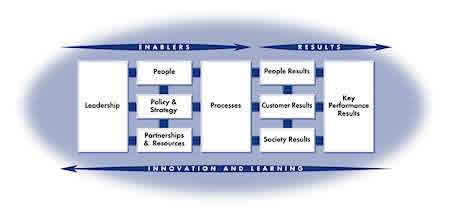
The model is one of the most widely used organizational frameworks in Europe.
Book: John S. Oakland - TQM: Text with Cases, Third Edition
| 👀 | TIP: To learn more, have a look at the EFQM center: Summary, forum, tips and tools. |
Compare EFQM with: Deming cycle | Kaizen | Balanced Scorecard | Baldridge | People CMM
Kaplan, Norton, The Strategy- Focused Organization
Fogg, Implementing Your Strategic Plan
Knight, VBM. Developing a systematic approach..
Brickley, Designing Organizations to Create Value
Ferris,
Valuation: Avoiding the Winner's Curse
Risher, Aligning Pay and Results
Edvinsson, Corporate Longitude
Standfield, Intangible Management
Lev, Intangibles: Management, Measurement, and Reporting
Smith, Valuation of Intellectual Property and Intangible Assets
About us | Advertise | Privacy | Support us | Terms of Service
©2026 JHM de Jonge - All names tm by their owners