
People CMM | P-CMM

|
People CMM | P-CMM |
|
|
Articles | Books | Dictionary | Faq | Home | Leaders | Organizations | Search
|
|
People Capability Maturity |
Continuously developing workforce maturity: Summary of the People CMM Model. Abstract |
® / ™ Carnegie Mellon Software Engineering Institute (SEI) |
The People Capability Maturity Model (People CMM) framework maintained by the Carnegie Mellon SEI helps organizations in developing their workforce maturity and in addressing their critical people issues. Based on the best current practices in fields such as human resources, knowledge management, and organizational development, P-CMM guides organizations in improving their processes for managing and developing their workforces.
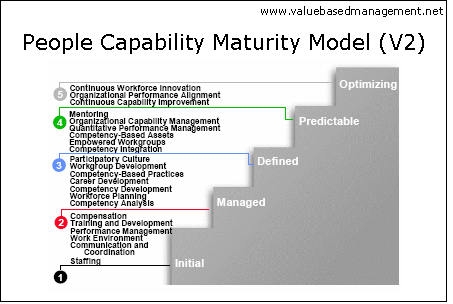
P-CMM helps organizations characterize the maturity of their workforce practices, establish a program of continuous workforce development, set priorities for improvement actions, integrate workforce development with process improvement, and establish a culture of excellence.
People CMM provides a roadmap for implementing workforce practices that continuously improve the capability of an organization’s workforce. Since an organization cannot implement all of the best workforce practices in an afternoon, P-CMM takes a staged approach. Each progressive level of the P-CMM produces a unique transformation in the organization’s culture by equipping it with more powerful practices for attracting, developing, organizing, motivating, and retaining its workforce. Thus, P-CMM establishes an integrated system of workforce practices that matures through increasing alignment with the organization’s business objectives, performance, and changing needs.
The philosophy underlying People CMM is based on ten
principles:
1. In mature organizations, workforce capability is directly related to
business performance.
2. Workforce capability is a competitive issue and a source of strategic
advantage.
3. Workforce capability must be defined in relation to the
organization’s strategic business
objectives.
4. Knowledge-intense work shifts the focus from job elements to
workforce competencies.
5. Capability can be measured and improved at multiple levels,
including individuals,
workgroups, workforce competencies, and the organization.
6. An organization should invest in improving the capability of those
workforce competencies
that are critical to its core competency as a business.
7. Operational management is responsible for the capability of the
workforce.
8. The improvement of workforce capability can be pursued as a process
composed from
proven practices and procedures.
9. The organization is responsible for providing improvement
opportunities, while individuals
are responsible for taking advantage of them.
10. Since technologies and organizational forms evolve rapidly,
organizations must continually
evolve their workforce practices and develop new workforce competencies.
The People Capability Maturity Model consists of five maturity levels that establish successive foundations for continuously improving individual competencies, developing effective teams, motivating improved performance, and shaping the workforce the organization needs to accomplish its future business plans. Each maturity level is a well-defined evolutionary plateau that institutionalizes new capabilities for developing the organization's workforce. By following the maturity framework, an organization can avoid introducing workforce practices that its employees are unprepared to implement effectively.
The five stages of the People CMM framework are:
P-CMM - Initial Level (Typical characteristics: Inconsistency in performing practices, Displacement of responsibility, Ritualistic practices, and Emotionally detached workforce).
P-CMM - Managed Level (Typical characteristics: Work overload, Environmental distractions, Unclear performance objectives or feedback, Lack of relevant knowledge, or skill, Poor communication, Low morale)
P-CMM - Defined Level (Although there are performing basic workforce practices, there is inconsistency in how these practices are performed across units and little synergy across the organization. The organization misses opportunities to standardize workforce practices because the common knowledge and skills needed for conducting its business activities have not been identified)
P-CMM - Predictable Level (The organization manages and exploits the capability created by its framework of workforce competencies. The organization is now able to manage its capability and performance quantitatively. The organization is able to predict its capability for performing work because it can quantify the capability of its workforce and of the competency-based processes they use in performing their assignments)
P-CMM - Optimizing Level (The entire organization is focused on continual improvement. These improvements are made to the capability of individuals and workgroups, to the performance of competency-based processes, and to workforce practices and activities. The organization uses the results of the quantitative management activities established at Maturity Level 4 to guide improvements at Maturity Level 5. Maturity Level 5 organizations treat change management as an ordinary business process to be performed in an orderly way on a regular basis)
| 👀 | TIP: To learn more, have a look at the People Capability Maturity center: Summary, forum, tips and tools. |
Compare with People CMM: Capability Maturity Model | Balanced Scorecard | Baldrige Award | EFQM | Change Approaches | Organizational Learning | Kaizen
About us | Advertise | Privacy | Support us | Terms of Service
©2026 JHM de Jonge - All names tm by their owners