
IAM - Sveiby

|
IAM - Sveiby |
|
|
Articles | Books | Dictionary | Faq | Home | Leaders | Organizations | Search
|
Intangible Assets Monitor |
Measuring the value of intangibles: Summary of Sveiby's IAM. Abstract |
© / ™Karl-Erik Sveiby |
The Intangible Assets Monitor (IAM) is a method for measuring intangible assets and a presentation format which displays a number of relevant indicators for measuring intangible Assets in a simple fashion. The choice of indicators depends on the company strategy. The format is particularly relevant for companies with large intangible assets.
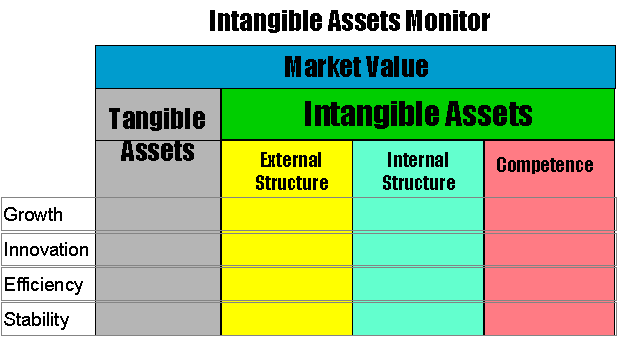
The IAM can be integrated in a management information system. The Monitor itself should not exceed one page. It should be accompanied by a number of comments. Only a few of the suggested indicators in this chapter should be selected. The most important areas to cover are growth/renewal, efficiency and stability. The purpose is to get a broad picture, so one or two indicators in each category should be designed. We are interested in indicators that indicate change, i.e. growth, and renewal as well as efficiency and stability measures. The Monitor can be used to design a management information system or to make an Audit.
When using IAM one perceives the three Intangible Assets as "real" assets.
IAM is interested in indicators that indicate change and knowledge flows, i.e. growth, renewal/innovation, efficiency/utilization and risk/ stability measures. The idea is to get a "peek" into how the intangible asset(s) are developing, by designing indicators that correlate with the growth of the asset in question, its renewal rate, how efficiently we are at utilizing it, and the risk of loosing it.
| 👀 | TIP: To learn more, have a look at the Intangible Assets center: Summary, forum, tips and tools. |
Compare with Intangible Assets Monitor: IC Rating | Balanced Scorecard | Strategy Maps | Performance Prism
Kaplan, Norton, The Strategy- Focused Organization
Edvinsson, Corporate Longitude
Standfield, Intangible Management
Lev, Intangibles: Management, Measurement, and Reporting
Smith, Valuation of Intellectual Property and Intangible Assets
About us | Advertise | Privacy | Support us | Terms of Service
©2026 JHM de Jonge - All names tm by their owners