
Communicating and Cascading the Strategy

|
Communicating and Cascading the Strategy |
|
|
Articles | Books | Dictionary | Faq | Home | Leaders | Organizations | Search
|
Strategy MapsKaplan and Norton |
How to Communicating and Cascade the Strategy? |
Summary of Strategy Maps. Abstract |
In their 2001 book The Strategy-Focused Organization, Kaplan and Norton transformed their Balanced Scorecard, in 1992 introduced in the Harvard Business Review as a performance measurement system, to a strategic management system. A lot of that transformation was done in introducing the so called 'Strategy Map' (SM)
What is a strategy map?
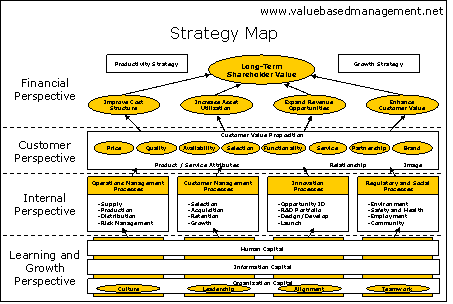
A SM is a diagram that describes how an organization creates value by connecting strategic objectives in explicit cause-and-effect relationship with each other in the four BSC objectives (financial, customer, processes, learning and growth). See the figure on the left. You can click on the graph to download a bigger one in pdf format. SMs are a strategic part of the Balanced Scorecard framework to describe strategies for value creation.
What are the main principles behind Strategy Maps?
Strategy balances contradictory forces.
Strategy is based on a differentiated customer value proposition.
Value is created through internal business processes.
Strategy consists of simultaneous, complementary themes.
Strategic alignment determines the value of intangible assets.
Creation Process
All of the information is contained on one page; this enables relatively easy strategic communication.
There are four perspectives: Financial; Customer; Internal; Learning and Growth.
The financial perspective looks at creating long-term shareholder value, and builds from a productivity strategy of improving cost structure and asset utilization and a growth strategy of expanding opportunities and enhancing customer value.
These last four elements of strategic improvement are supported by price, quality, availability, selection, functionality, service, partnerships and branding.
From an internal perspective, operations and customer management processes help create product and service attributes while innovation, regulatory and social processes help with relationships and image.
All of these processes are supported by the allocation of human, information and organizational capital. Organizational capital is comprised of company culture, leadership, alignment and teamwork.
Finally, cause and effect relationships are described by connecting arrows.
Why strategy maps?
By connecting such things as shareholder value creation, customer management, process management, quality management, core capabilities, innovation, human resources, information technology, organizational design and learning with one another in one graphical representation, strategy mapping help greatly in describing the strategy and to communicate the strategy among executives and to their employees. In this way alignment can be created around the strategy, which makes a successful implementation of the strategy more easy. No small thing, bearing in mind that often, the implementation of a constructed strategy is the biggest challenge.

Although the previous book of Kaplan and Norton already spent
64 pages on strategy maps, you can find the best and most
comprehensive treatment of them including lots of examples
in the book on the right:

More strategic management and corporate finance models
| 👀 | TIP: To learn more, have a look at the Strategy Maps center: Summary, forum, tips and tools. |
About us | Advertise | Privacy | Support us | Terms of Service
©2026 JHM de Jonge - All names tm by their owners