
Abraham Maslow biography - Hierarchy of Needs

|
Abraham Maslow biography - Hierarchy of Needs |
|
|
Articles | Books | Dictionary | Faq | Home | Leaders | Organizations | Search |
Abraham Maslow biography
 Abraham Maslow
was born April 1, 1908 in Brooklyn, New York. He was the first of seven
children born to his parents, who themselves were uneducated Jewish
immigrants from Russia. His parents, hoping for the best for their
children in the new world, pushed him hard for academic success. Not
surprisingly, he became very lonely as a boy, and found his refuge in
books.
Abraham Maslow
was born April 1, 1908 in Brooklyn, New York. He was the first of seven
children born to his parents, who themselves were uneducated Jewish
immigrants from Russia. His parents, hoping for the best for their
children in the new world, pushed him hard for academic success. Not
surprisingly, he became very lonely as a boy, and found his refuge in
books.
To satisfy his parents, he first studied law at the City College of New
York (CCNY). He married Bertha Goodman, his first cousin, against his
parents wishes. Abe and Bertha went on to have two daughters.
Abraham Maslow and Bertha moved to Wisconsin so that he could
attend the University of Wisconsin. Here, he became interested in
psychology, and his school work began to improve dramatically. He spent
time there working with Harry Harlow, who is famous for his experiments
with baby rhesus monkeys and attachment behavior.
Abraham Maslow received his BA in 1930, his MA in 1931, and his PhD
in 1934, all in psychology, all from the University of Wisconsin. A year
after graduation, he returned to New York to work with E. L. Thorndike at
Columbia, where Maslow became interested in research on human sexuality.
He began teaching full time at Brooklyn College. During this period of his
life, he came into contact with the many European intellectuals that were
immigrating to the US, and Brooklyn in particular, at that time -- people
like Adler, Fromm, Horney, as well as several Gestalt and Freudian
psychologists.
In 1951, Abraham Maslow served as the chair of the psychology
department at Brandeis for 10 years, where he met Kurt Goldstein (who
introduced him to the idea of self-actualization) and began his own
theoretical work. It was also here that he began his crusade for a
humanistic psychology -- something ultimately much more important to him
than his own theorizing.
 He spend his final years in semi-retirement in California, until, on June
8 1970, he died of a heart attack after years of ill health.
He spend his final years in semi-retirement in California, until, on June
8 1970, he died of a heart attack after years of ill health.
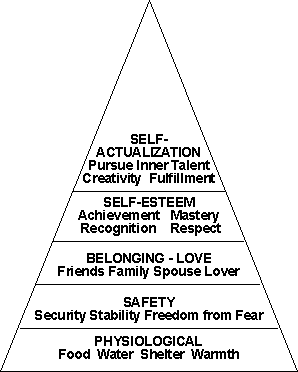
Each human being is motivated by needs. Our most basic needs are inborn, having evolved over tens of thousands of years. Abraham Maslow's Hierarchy of Needs helps to explain how these needs motivate us all.
Hierarchy of Needs - Physiological needs
These are the very basic needs such as air, water, food, sleep, sex, etc. When these are not satisfied we may feel sickness, irritation, pain, discomfort, etc. These feelings motivate us to alleviate them as soon as possible to establish homeostasis. Once they are alleviated, we may think about other things.
Hierarchy of Needs - Safety needs
These have to do with establishing stability and consistency in a chaotic world. These needs are mostly psychological in nature. We need the security of a home and family. However, if a family is dysfunction, i.e., an abusive husband, the wife cannot move to the next level because she is constantly concerned for her safety. Love and belongingness have to wait until she is no longer cringing in fear. Many in our society cry out for law and order because they do not feel safe enough to go for a walk in their neighborhood.
Hierarchy of Needs - Love and belongingness needs
These are next on the ladder. Humans have a desire to belong to groups: clubs, work groups, religious groups, family, gangs, etc. We need to feel loved (non-sexual) by others, to be accepted by others. Performers appreciate applause. We need to be needed.
Hierarchy of Needs - Self-Esteem needs
There are two types of esteem needs. First is self-esteem which results from competence or mastery of a task. Second, there's the attention and recognition that comes from others. This is similar to the belongingness level, however, wanting admiration has to do with the need for power.
Hierarchy of Needs - The need for self-actualization
This
is "the desire to become more and more what one is, to become everything
that one is capable of becoming." People who have everything can maximize
their potential. They can seek knowledge, peace, esthetic experiences,
self-fulfillment, oneness with God, etc.
Maslow's Hierarchy
of Needs model was developed between 1943-1954, and first widely published
in Motivation and Personality in 1954. At this time the Hierarchy of Needs
model comprised five needs. Maslow's most popular book is Toward a
Psychology of Being (1968), in which more layers were added. The original 5
layer-version still remains for most people the definitive Hierarchy of
Needs.

Compare: Spiral Dynamics
| Herzberg Two
Factor Theory |
Theory X Theory Y | ERG Theory
| Expectancy Theory | Hofstede
|
What is Value Based Management?
About us | Advertise | Privacy | Support us | Terms of Service
©2026 JHM de Jonge - All names tm by their owners