
Extended Enterprise Strategic Triangle

|
Extended Enterprise Strategic Triangle |
|
|
Articles | Books | Dictionary | Faq | Home | Leaders | Organizations | Search
|
The Delta Model |
Summary of Extended Enterprise Strategic Triangle. Abstract |
Arnoldo C. Hax Dean L. Wilde II |
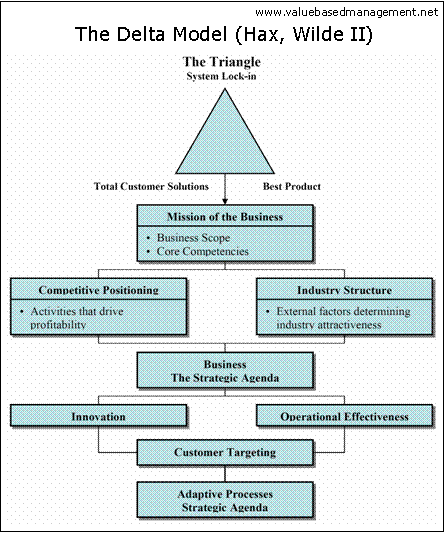
The Delta Model is a strategy (organizing) framework that was developed by Dean Wilde, along with other members of Dean & Company, and Arnoldo Hax of the MIT/Sloan School of Management. It is aimed at assisting managers in the articulation and implementation of effective corporate and business strategies.
The emergence of the Internet, with the
previously unimagined potentials for communication, and the technologies
surrounding e-business and e-commerce, made available some new
options tools that allowed the feasibility of new business approaches. Hax
and Wilde II integrate the
Competitive
Advantage and Value Chain
frameworks from Porter with the
Resource-Based
View on the Firm and complement those with new Extended
Enterprise perspectives
and with offering Total Customer Solutions.
The Delta Model contains the following elements:

Strategic Triangle: used for defining strategic positions that reflect fundamentally new sources of profitability (three strategic options: best product, customer solutions, and system lock-in),
Aligning these strategic options with a firm's activities and provides congruency between strategic direction and execution (three fundamental processes are always present and are the repository of key strategic tasks: operational effectiveness, customer targeting, and innovation), and
Adaptive processes: core processes of the company must be aligned to the chosen strategy in order to make progress against the strategic agenda and avoid a commodity-like outcome. The Delta Model identifies the core processes of the business and provides a guide for how they need to function differently to achieve different strategic positions capable of continually responding to an uncertain environment.
Metrics (Aggregate Metrics that should be supplemented with Granular Metrics).
Hax and Wilde believe a firm owes itself to its customers. They are the ultimate repository of all the firm’s activities. At the heart of management and, certainly, at the heart of strategy, resides the customer. We have to serve the customer in a distinctive way if we expect to enjoy superior performance. The name of the game is to attract, to satisfy, and to retain the customer.
The intimacy and connectivity of the networked economy offer opportunities to create competitive positions based upon the structure of the customer relationship.
A business can establish an unbreakable link, deep knowledge, and close relationship that we refer to as customer bonding. These bonds can be directly formed with the customer, or indirectly formed through the complementors that the customer wishes to access.
Both are powerful sources of margin and sustainability. The bonds represent investments made by customers and complementors in and around the business’ product.
| 👀 | TIP: To learn more, have a look at the Extended Enterprise center: Summary, forum, tips and tools. |
Compare with The Delta Model: Competitive Advantage | Value Chain | Resource-Based View | Core Competence Prahalad | Porter Competitive Forces | Just-in-time | TDC matrix | Outsourcing | Impact/value framework | Strategic Thrusts | Bricks & Clicks | Twelve Principles of the Network Economy
About us | Advertise | Privacy | Support us | Terms of Service
©2026 JHM de Jonge - All names tm by their owners