
Five Competitive Forces Model Porter

|
Five Competitive Forces Model Porter |
|
|
Articles | Books | Dictionary | Faq | Home | Leaders | Organizations | Search
|
Summary/Abstract
Outside-in business unit strategy<
The Five Forces model of Porter is an outside-in business unit strategy tool that is used to make an analysis of the attractiveness (value...) of an industry structure. The Competitive Forces analysis is made by the identification of 5 fundamental competitive forces:
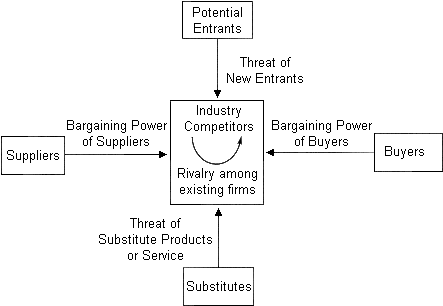
as a sixth factor could be added:
Porter's competitive forces model is probably one of the most often used business strategy tools and has proven its usefulness on numerous occasions. Porter's model is particularly strong in thinking outside-in. Care should therefore be taken not to underestimate or underemphasize the importance of the (existing) strengths of the organization (inside-out) when applying this five competitive forces framework of Porter.
From a Value Based Management point of view, the Five Forces model (Market/Industry Attractiveness) of Porter can be seen as one of two dimensions in maximizing corporate value creation. The other value creation dimension is how well a company performs relatively towards its competitors (Relative Competitive Position), for which two other Porter-models are frequently used: the Value Chain framework and Porter's Competitive Advantage.

| 👀 | TIP: To learn more, have a look at the Porter's Five Forces center: Summary, forum, tips and tools. |
See also: Porter Competitive Advantage | Four Trajectories of Industry Change | Parenting Advantage | Prahalad | Delta Model | Resource-Based View | BCG Matrix | Greiner | Kay | Mintzberg | 3C's | Porter Diamond Model | Bricks and Clicks | Twelve Principles of the Network Economy
About us | Advertise | Privacy | Support us | Terms of Service
©2026 JHM de Jonge - All names tm by their owners