
GE Matrix

|
GE Matrix |
|
|
Articles | Books | Dictionary | Faq | Home | Leaders | Organizations | Search
|
McKinsey Matrix |
Summary of the GE Matrix. Abstract |
The GE matrix / McKinsey matrix (MKM) is a model to perform a business portfolio analysis on the Strategic Business Units of a corporation.
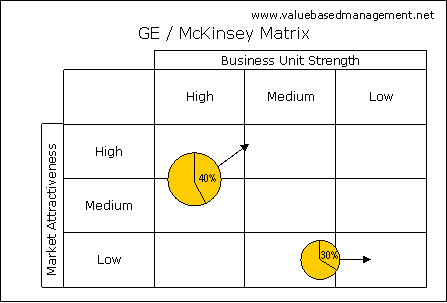
A business portfolio is the collection of Strategic Business Units that make up a corporation. The optimal business portfolio is one that fits perfectly to the company's strengths and helps to exploit the most attractive industries or markets. A Strategic Business Unit (SBU) can either be an entire mid-size company or a division of a large corporation, that formulates its own business level strategy and has separate objectives from the parent company.
The aim of a portfolio analysis is:
1) Analyze its
current business portfolio and decide which SBU's should receive more or
less investment, and
2) Develop growth strategies for adding new products and businesses to the
portfolio
3) Decide which businesses or products should no
longer be retained.
The BCG Matrix
(Boston Consulting Group Matrix) is the best-known portfolio planning framework. The MKM is a later and more advanced form of the BCG Matrix.
MKM versus BCG Matrix
The MKM is more sophisticated than the BCG Matrix
in three aspects:
1. Market (Industry) attractiveness replaces market growth as the dimension of industry attractiveness. Market Attractiveness includes a broader range of factors other than just the market growth rate that can determine the attractiveness of an industry / market. Compare also: Porter's Five Competitive Forces model
2. Competitive strength replaces market share as the dimension by which the competitive position of each SBU is assessed. Competitive strength likewise includes a broader range of factors other than just the market share that can determine the competitive strength of a Strategic Business Unit.
3. Finally the MKM works with a 3*3 grid, while the BCG Matrix has only 2*2. This also allows for more sophistication.
|
Typical (external) factors that affect Market Attractiveness:
- Entry barriers
- Demand
variability - Technology development
|
Typical (internal) factors that affect Competitive Strength of a Strategic Business Unit:
- Market share
growth - Relative
profit margins (compared to competitors) - Quality - Management strength
|
Often, Strategic
Business Units are portrayed as a circle plotted in the MKM, whereby:
- The size of the circles represent the Market Size
- The size of the pies represent the Market Share of the SBU's
- Arrows represent the direction and the movement of the SBU's in the future
A six-step
approach to implementation of portfolio analysis (using the MKM) could look like this:
1. Specify drivers of each dimension. The corporation must carefully
determine those factors that are important to its overall strategy
2. Weight drivers. The corporation must assign relative importance weights
to the drivers
3. Score SBU's each driver
4. Multiply weights times scores for each SBU
5. View resulting graph and interpret it
6. Perform a review/sensitivity analysis using adjusted other weights
(there may be no consensus) and scores.
Some important limitations of the MKM are:
- Valuation of the realization of the various factors
- Aggregation of the indicators is difficult
- Core competencies are not represented
- Interactions between Strategic Business Units are not considered
This method is also called "Business Assessment Array" and "GE Business Screen".
| 👀 | TIP: To learn more, have a look at the McKinsey Matrix center: Summary, forum, tips and tools. |
See also: BCG Matrix | ADL Matrix | Positioning | STRATPORT | Profit Pools | Four Trajectories of Industry Change | Product Life Cycle | Blue Ocean Strategy
About us | Advertise | Privacy | Support us | Terms of Service
©2026 JHM de Jonge - All names tm by their owners