
Red Ocean Strategy

|
Red Ocean Strategy |
|
|
Articles | Books | Dictionary | Faq | Home | Leaders | Organizations | Search
|
Blue Ocean Strategy |
Creating uncontested market space: Summary of Red and Blue Ocean Strategy. Abstract |
W. Chan Kim (2004) Renée Mauborgne |
Rather than competing within the confines of the existing industry or trying to steal customers from rivals (Bloody or Red Ocean Strategy) in the HBR of October 2004 W. Chan Kim and Renée Mauborgne suggest Blue Ocean Strategy: developing uncontested market space that makes the competition irrelevant.
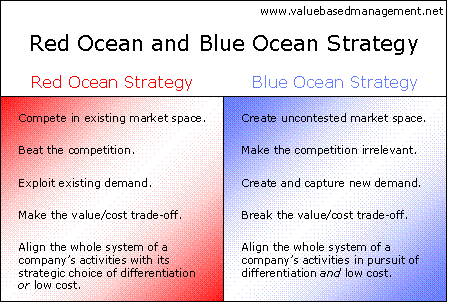
According to Kim and Mauborgne, competing in overcrowded industries is no way to sustain high performance. The real opportunity is to create blue oceans of uncontested market space.
Of course competition matters. But by focusing on competition and "competitive advantage", according to Kim and Mauborgne, scholars, companies, and consultants have ignored two very important - and far more lucrative - aspects of strategy:
- One is to find and develop blue oceans, and
- The other is to exploit and protect blue oceans. These challenges
are very different from those to which strategists have devoted most of
their attention.
In blue oceans, demand is created rather than fought over. There is ample opportunity for growth that is both profitable and rapid.
There are two ways to create blue oceans:
- One is to launch completely new industries, as eBay did with online auctions.
- It is more common for a blue ocean to be created from within a red ocean when a company expands the boundaries of an existing industry.
Certainly Kim and Mauborge deserve credits for having made the point of
the over-focus on competitive advantage and also for their beautiful
metaphor of the two types of oceans. Hopefully, the authors will provide
more specific tools to find, create, develop, exploit and protect blue
oceans in their forthcoming book (2005).
| 👀 | TIP: To learn more, have a look at the Blue Ocean Strategy center: Summary, forum, tips and tools. |
Compare with Blue Ocean Strategy: Business Process Reengineering | Product Market Grid | Core Competence | BCG Matrix | McKinsey Matrix | Resource-Based View
About us | Advertise | Privacy | Support us | Terms of Service
©2026 JHM de Jonge - All names tm by their owners