
OODA Model

|
OODA Model |
|
|
Articles | Books | Dictionary | Faq | Home | Leaders | Organizations | Search
|
OODA Loop |
Summary of OODA Model by Boyd. Abstract |
John Boyd |
The OODA Model (Observe, Orient, Decide, and Act) is an information strategy concept for information warfare developed by Colonel John Boyd (1927-1997). Although OODA was clearly created for military purposes, elements of the same theory can also be applied to business strategy. Boyd developed the theory based on his earlier experience as a fighter pilot and work on energy maneuverability. He initially used it to explain victory in air-to-air combat, but in the last years of his career he expanded his OODA theory into a grand strategy that would defeat an enemy strategically by “psychological” paralysis.
Boyd emphasized that strategy should always revolve around changing the enemy’s behavior, not annihilating his forces. The parallel between Boyd’s ideas and Sun Tzu’s masterpiece, “The Art of War,” are obvious. Both Boyd and Sun Tzu advocate the ideas of harmony, deception, swiftness and fluidity of action, surprise, shock, and attacking the enemy’s strategy.
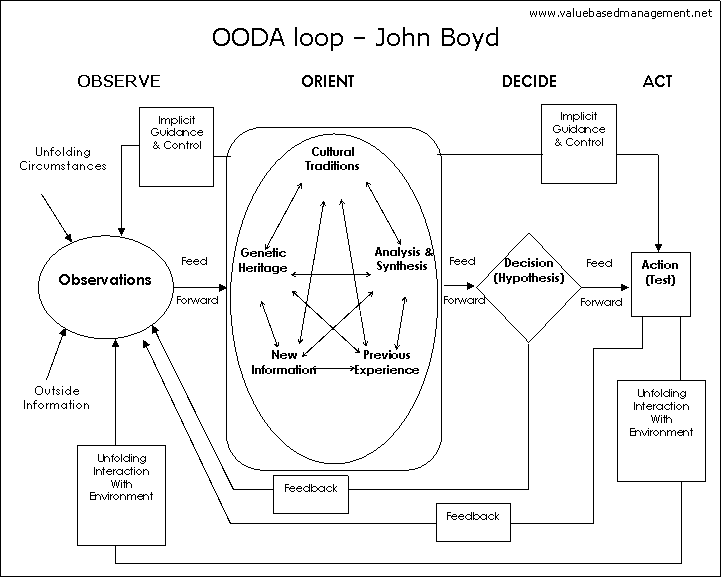
Chart adapted from Chester W. Richards, “A Swift, Elusive Sword: What if Sun Tzu and John Boyd did a National Defense review,” Center for Defense Information, February 2003, 22. |
Colonel Boyd viewed the enemy (and ourselves) as a system that is acting through a decision making process based on observations of the world around it. The enemy will observe unfolding circumstances and gather outside information in order to orient the system to perceived threats. Boyd states that the orientation phase of the loop is the most important step, because if the enemy perceives the wrong threats, or misunderstands what is happening in the environment around him, then he will orient his thinking (and forces) in wrong directions and ultimately make incorrect decisions. Boyd said that this cycle of decision-making could operate at different speeds for the enemy and your own organization. The goal should be to to complete your OODA process at a faster tempo than the enemy’s, and to take action to lengthen the enemy’s loop. One tries to conduct many more loops “inside” the enemies OODA, causing the enemy to be unable to react to anything that is happening to him.
Colonel Boyd stated that the the enemy’s OODA cycle can be lengthened through a variety of means. Boyd’s aim is to generate “non-cooperate” centers of gravity for the enemy through ambiguity, deception, novel circumstances, fast transient maneuvers, and the use of Sun-Tzu’s idea of Cheng and Ch’i. By isolating the enemy’s centers of gravity and developing mistrust and cohesion within the system (making them “non-cooperative”), friction will be greatly increased, paralysis in the system will set in, and the enemy will ultimately collapse. By attacking the thought process of the enemy / competitor, his morale and decision process can be shattered.
Book: Sun Tzu, Gary Gagliardi - The Art of War
Book: Carl Von Clausewitz - On War
| 👀 | TIP: To learn more, have a look at the OODA Loop center: Summary, forum, tips and tools. |
Compare with the OODA Loop: Deming cycle | Organic Organization | Force Field Analysis | Scenario Planning | PEST Analysis | SWOT Analysis | System Dynamics
About us | Advertise | Privacy | Support us | Terms of Service
©2026 JHM de Jonge - All names tm by their owners