
TPB Ajzen

|
TPB Ajzen |
|
|
Articles | Books | Dictionary | Faq | Home | Leaders | Organizations | Search
|
Theory of Planned Behavior |
Summary of the TPB by Ajzen. Abstract |
Icek Ajzen |
The Theory of Planned Behavior (TPB) of Icek Ajzen (1988, 1991) helps to understand how we can change the behavior of people. The TPB is a theory which predicts deliberate behavior, because behavior can be deliberative and planned.
TPB is the successor of the similar Theory of Reasoned Action of Ajzen and Fishbein (1975, 1980). The succession was the result of the discovery that behavior appeared not to be 100% voluntary and under control, which resulted in the addition of perceived behavioral control. With this addition the theory was called the Theory of Planned Behavior.
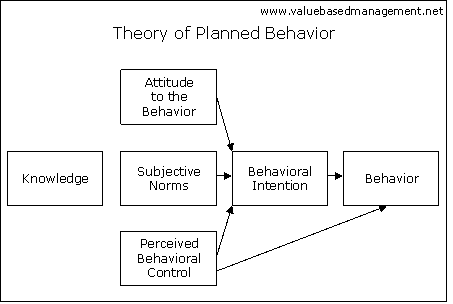
Briefly, according to TPB, human action is guided by three kinds of considerations:
1. Behavioral Beliefs (beliefs about the likely consequences of the behavior)
2. Normative Beliefs (beliefs about the normative expectations of others)
3. Control Beliefs (beliefs about the presence of factors that may facilitate or impede performance of the behavior).
Ajzen's three considerations are crucial in circumstances / projects / programs when changing behavior of people.
In their respective aggregates, behavioral beliefs produce a favorable or unfavorable attitude toward the behavior, normative beliefs result in perceived social pressure or subjective norm, and control beliefs give rise to perceived behavioral control. In combination, attitude toward the behavior, subjective norm, and perception of behavioral control lead to the formation of a behavioral intention. As a general rule, the more favorable the attitude and subjective norm and the greater the perceived control, the stronger should be the person’s intention to perform the behavior in question.
Recently (2002) Ajzen investigated Residual Effects of Past on Later Behavior. He came to the conclusion that this factor indeed exists but cannot be described to habituation as many people think. A review of existing evidence suggests that the residual impact of past behavior is attenuated when measures of intention and behavior are compatible and vanishes when intentions are strong and well formed, expectations are realistic, and specific plans for intention implementation have been developed.
A research project in the travel industry resulted in the conclusion that past travel choice contributes to the prediction of later behavior only if circumstances remain relatively stable.
Example: The Theory of Planned Behavior of Ajzen can help to explain why advertising campaigns merely providing information do not work. Increasing knowledge alone does not help to change behavior very much. Campaigns that aim at attitudes, perceived norms and control in making the change or buying certain goods have better results.
Similarly in Value Based Management, programs that focus only on explanation of the importance of Managing for Value (knowledge transfer) will likely not succeed. Rather one should convince people to change their intention to change by giving a lot of attention to attitudes, subjective norms and perceived behavior control.
Book: Icek Ajzen, Martin Fishbein - Understanding Attitudes and Predicting Social Behavior
| 👀 | TIP: To learn more, have a look at the Theory of Planned Behavior center: Summary, forum, tips and tools. |
Compare: Change Phases | Six Change Approaches | Change Model Beckhard | Force Field Analysis | Bases of Social Power | Core Groups | Business Process Reengineering | Kaizen | Change Management | Managing for Value | Levels of Culture | Changing Organization Cultures | Framing
About us | Advertise | Privacy | Support us | Terms of Service
©2026 JHM de Jonge - All names tm by their owners